SEO audit automation
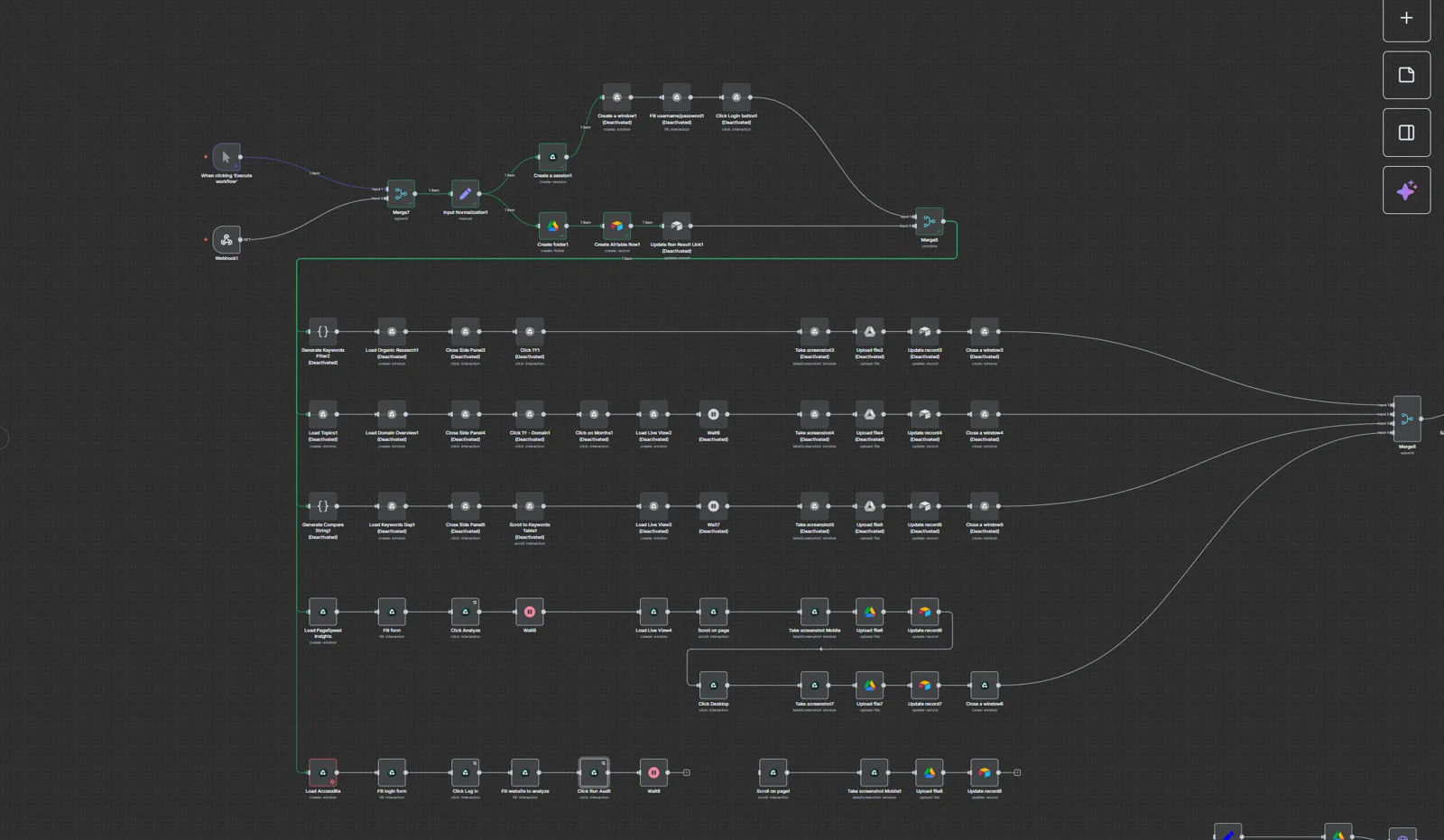
A marketing agency's website audit went from 4 to 7 hours of hand work per site to under an hour of review. The workflow I delivered runs nine tools and builds the slide deck, with AI drafting the findings.
Project snapshot
- Industry
- Marketing
- Input modalities
- Website and SEO tool outputs
The situation
Each audit meant running nine separate tools by hand, taking screenshots, writing up the findings and building the deck. That took 4 to 7 hours per site.
What I recommended and set up
The agency's earlier automation had run into problems. I rebuilt it so that entering a site starts everything. The tools run, the screenshots land in the agency's slide template, and AI drafts the findings for a person to review.
What changed after delivery
- Before: 4 to 7 hours per site to collect results, take screenshots, write the analysis and build the deck.
- After: under an hour of review per site.
- A list of sites can be queued and run as one batch.
- Each deck is a draft for a person to review before it goes out.
The result
- 70 to 85% less time to produce an audit.
How the audit was done by hand
A marketing agency sends website audits to prospective clients. Building one meant running nine separate tools by hand: page speed on mobile and desktop, accessibility, privacy, security, search visibility against competitors, and the technology the site is built on. Someone took a screenshot of each result, wrote up what it meant, and assembled the deck.
That took 4 to 7 hours per site.
What had gone wrong before
The agency had already tried to automate it, and that attempt had run into problems. When I started:
- Screenshots broke whenever a tool changed its interface.
- One tool was blocked by a CAPTCHA, and another was blocked for a reason nobody had found.
- New entries in the agency's table did not start the workflow.
- The agency had been advised that screenshot output might not be possible in a first version, and was considering HTML output instead.
What I set up
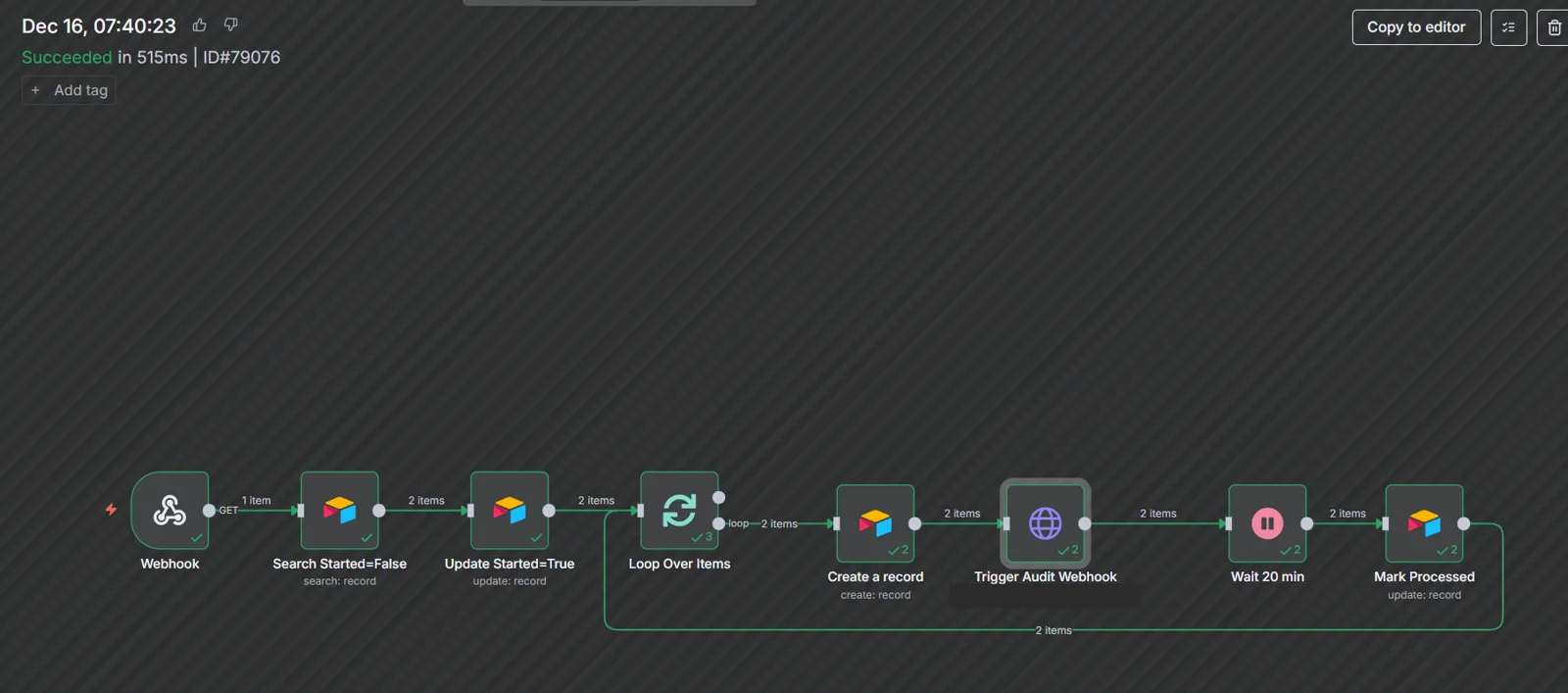
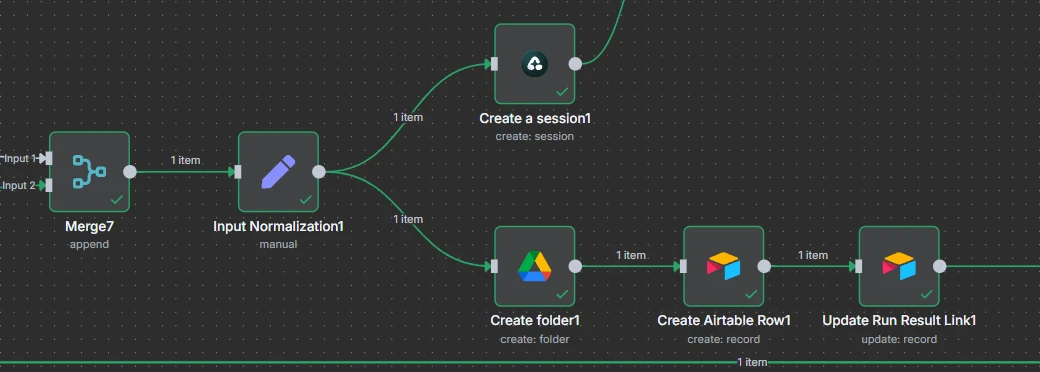
- One place to start. The team adds a site to a table, or uploads a whole list. Each entry starts a run.
- The tools run themselves. For each tool, the workflow opens a browser session, signs in where the tool needs it, runs the check on the site and takes the screenshot. For one tool I switched to its official API, which removed the CAPTCHA problem.
- Everything is filed. Screenshots go to the agency's Google Drive, with links recorded against the site.
- The deck builds itself. The workflow copies the agency's own Google Slides template and places each screenshot, resized and cropped to fit.
- A first draft of the findings. For each audit screen, AI drafts the findings, following the agency's own prompt rules.
- A queue for batches. A list of sites runs one after another, so a long list stays within the platform's concurrency limits.
- Logs. Every run is logged and monitored.
Each deck is a draft for a person to review before it goes to a prospect. The workflow does the collecting and the first draft. The agency keeps the judgment.
How it went
- September 2025. Work started on the earlier workflow.
- Mid-December. Screenshot capture was complete. The findings had not been started.
- Week ending 19 December. Findings were done for 4 of the 11 audit screens, and bulk runs had been redesigned around the platform's concurrency limits.
- Week ending 26 December. A complete run with no manual steps: site in, deck out.
- January 2026. The engagement closed.
Before and after
- Before: 4 to 7 hours per site.
- After: under an hour of review per site.
- 70 to 85% less time to produce an audit, and three to five times the audit throughput.
The agency rated the work 5 out of 5 on Upwork (opens in a new tab) and endorsed it as "Committed to Quality", "Solution Oriented" and "Accountable for Outcomes".
More screens from this project